
Latest News
Final-test leaderboards are available
Task 1 and Task 2 final-test results are now released after organizer-side validation. Teams can use the official rankings and scores in their CLEF Working Notes papers.
Ranking-level metrics only are published. Hidden labels and participant answers remain private.
Task 1 final results are released
Official final-test leaderboards are available for English, Chinese, Arabic, and Hindi after organizer-side validation.
Submission status remains available from the Task 1 hub.
Task 3 endpoint checks are underway
Submit or update your Task 3 endpoint by the extended deadline. Organizers verify submitted endpoints before the common live evaluation window.
Already-passing teams do not need to resubmit unless endpoint details changed.
Seven FinMMEval 2026 papers recognized
Six team-level cash awards totaling USD 1,800, plus one Special Recognition Award.
The separate CLEF main conference paper track is not used for FinMMEval awards.
About the Lab
FinMMEval Lab integrates financial reasoning, multilingual understanding, and decision-making into a unified evaluation suite designed to promote robust, transparent, and globally competent financial AI. The 2026 edition introduces three interconnected tasks spanning five languages.
Multi-modal inputs: news, filings, macro indicators, tests.
Multiple languages with low-resource representations: English, Chinese, Arabic, Hindi, Greek, Japanese, Spanish.
Tasks spanning Q&A, and decision making.
Metrics centered on Accuracy, ROUGE-1, BLEURT and performance quantitative metrics (e.g. CR, SR, MD).
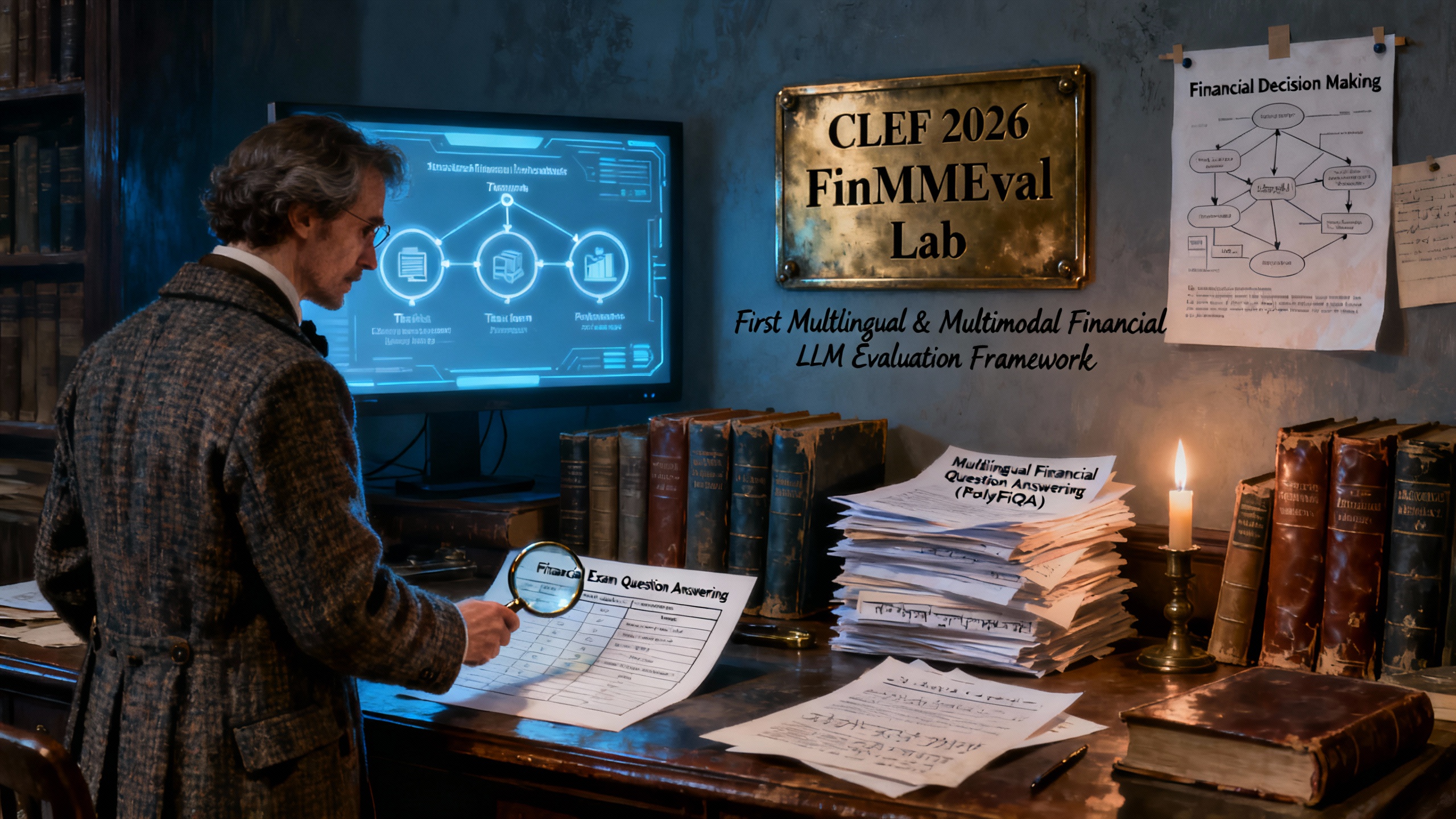
"How can I tailor my setup to make an LLM exceptionally good at finance?"
Tasks
Choose one or more tasks. Follow the task-specific submission format; Task 1 and Task 2 do not require confidence scores. For Task 1 and Task 2, dataset expansion and/or real-time retrieval during inference are allowed, but these must be clearly disclosed in the submitted system paper.
Task 1 - Financial Exam Q&A
Given a stand-alone multiple-choice question Q with four candidate options { A1, A2, A3, A4 }, the system must select the correct answer A∗. Questions cover valuation, accounting, ethics, corporate finance, and regulatory knowledge.
Motivation
Professional financial qualification exams (e.g., CFA, EFPA) require the integration of theoretical and regulatory knowledge with applied reasoning. Existing LLMs often rely on factual recall without demonstrating the analytical rigor expected from human candidates.
Data
- EFPA (Spanish): 50 exam-style financial questions on investment and regulation.
- GRFinQA (Greek): 225 multiple-choice finance questions from university-level exams.
- CFA (English): 600 exam-style multiple-choice questions covering nine core domains.
- CPA (Chinese): 300 exam-style financial questions focusing on major modules.
- BBF (Hindi): 500-1000 exam-style financial multiple-choice questions covering over 30 domains.
Official Data Usage
The FinMMEval Hugging Face collection is the official public data release for Task 1. Participants may use the released datasets for training and may reorganize or re-split them as needed. The original split names on dataset cards do not restrict participant usage.
Evaluation
Models are required to output the correct answer label. Performance is measured by accuracy, defined as the proportion of correctly identified options in the test set.
Submission Policy
For Task 1, dataset expansion and/or real-time retrieval during inference are allowed. Please clearly disclose any such components, together with the overall inference setup, in your submitted system paper.
The released Task 1 dev leaderboards use separate organizer-held evaluation data. Those public dev sets are for validation only and should not be used for training. The remaining hidden test sets are reserved for final evaluation.
At present, we do not enforce a hard submission cap for Task 1. Participants may submit multiple times as needed during development, but should avoid unnecessary rapid resubmission.
Task 1 Submission
A unified Task 1 submission hub is available for released language-specific dev benchmarks. These public dev leaderboards are validation tracks only and are separate from the official public training collection.
Important Dates
Current lab milestones and submission deadlines.
-
Lab registration opens17 November 2025
-
Training data released15 December 2025 • Available now via the Hugging Face collection
-
Lab registration closes23 April 2026
-
Task 3 endpoint submission deadline10 May 2026 AoE
-
Task 1/2 dev leaderboards and test questions release06 May 2026
-
Task 1/2 final run submission deadline and leaderboard release25 May 2026 AoE submission deadline; final leaderboards released on 27 May 2026
-
Deadline for the submission of working notes [CEUR-WS]28 May 2026
-
Review process of participant papers28 May – 30 June 2026
-
Submission of Condensed Lab Overviews [LNCS]08 June 2026
-
Notification of Acceptance for Condensed Lab Overviews [LNCS]15 June 2026
-
Camera Ready Copy of Condensed Lab Overviews [LNCS] due22 June 2026
-
Notification of Acceptance for Participant Papers [CEUR-WS]30 June 2026
-
Camera Ready Copy of Participant Papers and Extended Lab Overviews [CEUR-WS] due06 July 2026
-
CLEF 2026 Conference21–24 September 2026 • Jena, Germany
Awards
The 2026 recipients were selected using both leaderboard performance and the quality of their submitted CLEF Working Notes papers. Six team-level cash awards total USD 1,800, alongside one Special Recognition Award.
Single award based on overall excellence, considering both leaderboard performance and paper quality.
Three awards recognizing strong systems, clear methodology, and high-quality papers.
- Infraglyph
- Pranshu Rastogi
- fosu ltw
Two awards highlighting promising approaches and well-documented submissions.
- CLaC
- Fin-Analyst
One additional award recognizing a notable contribution beyond the six cash award slots.
Award basis and scope
FinMMEval 2026 awards were evaluated over participant submissions and their CLEF Working Notes papers. They are not evaluated through the separate CLEF main conference paper track. Participants may later develop a substantially extended version for another conference or journal, subject to that venue's originality, prior-publication, and dual-submission policies.
How to Participate
Engage with the challenges in a way that suits you - from a quick, one-time experiment to a detailed research project. To document an official FinMMEval participant system and be considered for FinMMEval awards, submit a CLEF Working Notes participant paper for the lab.
The CLEF main conference paper track is separate from the FinMMEval lab working notes. Promising systems may later be developed into a substantially extended conference or journal paper, subject to the target venue's policies.
Ready to join?
Sign up via the CLEF registration form (FinMMEval section)
Task 1 Submission
The Task 1 final-test leaderboards for English, Chinese, Arabic, and Hindi are now available. The submission hub remains linked for reference.
Task 2 Final Results
The Task 2 final-test leaderboard is now available. Completed submissions are ranked by ROUGE-1 F1, the primary metric for the task.
Open Final ResultsWorking Notes Template
FinMMEval participant working notes should follow the CLEF 2026 Labs Working Notes format. Papers are expected to be written in English, use the 1-column CEURART template, and be at least 5 pages long. There is no maximum page limit.
Paper title format
FinMMEval working-notes titles must clearly include the team/system name, FinMMEval 2026, and the task number(s). The title in EasyChair should exactly match the title in the PDF.
- <Team Name> @ FinMMEval 2026 Task <X>: <Short System Description>
- <Team Name> @ FinMMEval 2026: Systems for Tasks 1 and 2
- If the team name already contains "@", for example DS@GT, DS@GT at FinMMEval 2026 Task 2: ... is also acceptable.
See the CLEF 2026 submission instructions for the official working-notes requirements. A generic CEURART Overleaf template is also available as a reference.
Packaging Checklist
-
✓Results JSONL (per task)
-
✓System Card (architecture, data usage, risks)
-
✓For Task 1/2, clearly disclose any dataset expansion or real-time retrieval used during inference
-
✓Reproducibility (seed, versions, hardware)
-
✓License compliance acknowledgements (if applicable)
Recommended Citations
Please cite the FinMMEval Lab overview paper when referring to the full lab. If your work is associated with a specific task, please also cite the corresponding task overview paper.
How to cite FinMMEval
- All FinMMEval participants should cite the FinMMEval Lab overview paper.
- Participants in a specific task should also cite that task’s overview paper.
- Task 1 participants should additionally cite the relevant source paper(s): RealFin for English/Chinese, BhashaBench V1 / BhashaBench-Finance for Hindi, and SAHM for Arabic.
- Task 2 participants should additionally cite MultiFinBen.
- Task 3 participants should additionally cite Agent Market Arena / When Agents Trade.
Some source papers have been accepted but are not yet available in the official proceedings. We provide the arXiv citations below for now and will update them to the official proceedings BibTeX once available.
FinMMEval Lab Overview
LNCS@inproceedings{FinMMEval2026,
title = {Overview of {FinMMEval} 2026: Multilingual and Multimodal Financial Evaluation},
author = {Zhuohan Xie and Yuyang Dai and Rania Elbadry and Vanshikaa Jani and Xueqing Peng and Lingfei Qian and Georgi Georgiev and Dimitar Dimitrov and Fan Zhang and Jimin Huang and Jiahui Geng and Yankai Chen and Ye Yuan and Haolun Wu and Yuxia Wang and Ivan Koychev and Veselin Stoyanov and Mingzi Song and Yu Chen and Xue Liu and Preslav Nakov},
booktitle = {Experimental IR Meets Multilinguality, Multimodality, and Interaction},
series = {Proceedings of the Seventeenth International Conference of the CLEF Association (CLEF 2026)},
year = {2026},
month = {September 21--24},
address = {Jena, Germany},
publisher = {Springer Lecture Notes in Computer Science LNCS},
}Task 1 Overview
CEUR-WS@inproceedings{FinMMEvalTask1Overview2026,
title = {Overview of the {FinMMEval} 2026 Task 1: Multilingual Financial Multiple-Choice Question Answering},
author = {Zhuohan Xie and Yuyang Dai and Rania Elbadry and Vanshikaa Jani and Georgi Georgiev and Dimitar Dimitrov and Fan Zhang and Xueqing Peng and Lingfei Qian and Jimin Huang and Jiahui Geng and Yankai Chen and Ye Yuan and Haolun Wu and Yuxia Wang and Ivan Koychev and Veselin Stoyanov and Mingzi Song and Yu Chen and Xue Liu and Preslav Nakov},
booktitle = {CLEF 2026 Working Notes},
series = {CEUR Workshop Proceedings},
year = {2026},
month = {September 21--24},
address = {Jena, Germany},
publisher = {CEUR-WS.org},
}Task 2 Overview
CEUR-WS@inproceedings{FinMMEvalTask2Overview2026,
title = {Overview of the {FinMMEval} 2026 Task 2: Financial Question Answering and Summarization},
author = {Zhuohan Xie and Xueqing Peng and Georgi Georgiev and Dimitar Dimitrov and Rania Elbadry and Fan Zhang and Lingfei Qian and Jimin Huang and Vanshikaa Jani and Yuyang Dai and Jiahui Geng and Yankai Chen and Ye Yuan and Haolun Wu and Yuxia Wang and Ivan Koychev and Veselin Stoyanov and Mingzi Song and Yu Chen and Xue Liu and Preslav Nakov},
booktitle = {CLEF 2026 Working Notes},
series = {CEUR Workshop Proceedings},
year = {2026},
month = {September 21--24},
address = {Jena, Germany},
publisher = {CEUR-WS.org},
}Task 3 Overview
CEUR-WS@inproceedings{FinMMEvalTask3Overview2026,
title = {Overview of the {FinMMEval} 2026 Task 3: Financial Decision Making},
author = {Zhuohan Xie and Lingfei Qian and Georgi Georgiev and Dimitar Dimitrov and Rania Elbadry and Fan Zhang and Xueqing Peng and Jimin Huang and Vanshikaa Jani and Yuyang Dai and Jiahui Geng and Yankai Chen and Ye Yuan and Haolun Wu and Yuxia Wang and Ivan Koychev and Veselin Stoyanov and Mingzi Song and Yu Chen and Xue Liu and Preslav Nakov},
booktitle = {CLEF 2026 Working Notes},
series = {CEUR Workshop Proceedings},
year = {2026},
month = {September 21--24},
address = {Jena, Germany},
publisher = {CEUR-WS.org},
}Task Source and Platform Papers
arXiv@misc{dai2026realfin,
title = {{RealFin}: How Well Do {LLM}s Reason About Finance When Users Leave Things Unsaid?},
author = {Yuyang Dai and Yan Lin and Zhuohan Xie and Yuxia Wang},
year = {2026},
eprint = {2602.07096},
archivePrefix = {arXiv},
primaryClass = {q-fin.ST},
doi = {10.48550/arXiv.2602.07096},
url = {https://arxiv.org/abs/2602.07096},
}
@misc{devane2025bhashabenchv1,
title = {{BhashaBench V1}: A Comprehensive Benchmark for the Quadrant of Indic Domains},
author = {Vijay Devane and Mohd Nauman and Bhargav Patel and Aniket Mahendra Wakchoure and Yogeshkumar Sant and Shyam Pawar and Viraj Thakur and Ananya Godse and Sunil Patra and Neha Maurya and Suraj Racha and Nitish Kamal Singh and Ajay Nagpal and Piyush Sawarkar and Kundeshwar Vijayrao Pundalik and Rohit Saluja and Ganesh Ramakrishnan},
year = {2025},
eprint = {2510.25409},
archivePrefix = {arXiv},
primaryClass = {cs.CL},
url = {https://arxiv.org/abs/2510.25409},
}
@misc{elbadry2026sahm,
title = {{SAHM}: A Benchmark for Arabic Financial and Shari'ah-Compliant Reasoning},
author = {Rania Elbadry and Sarfraz Ahmad and Ahmed Heakl and Dani Bouch and Momina Ahsan and Muhra AlMahri and Marwa Elsaid khalil and Yuxia Wang and Salem Lahlou and Sophia Ananiadou and Veselin Stoyanov and Jimin Huang and Xueqing Peng and Preslav Nakov and Zhuohan Xie},
year = {2026},
eprint = {2604.19098},
archivePrefix = {arXiv},
primaryClass = {cs.CL},
doi = {10.48550/arXiv.2604.19098},
url = {https://arxiv.org/abs/2604.19098},
}
@misc{peng2025multifinben,
title = {{MultiFinBen}: Benchmarking Large Language Models for Multilingual and Multimodal Financial Application},
author = {Xueqing Peng and Lingfei Qian and Yan Wang and Ruoyu Xiang and Yueru He and Yang Ren and Mingyang Jiang and Vincent Jim Zhang and Yuqing Guo and Jeff Zhao and Huan He and Yi Han and Yun Feng and Yuechen Jiang and Yupeng Cao and Haohang Li and Yangyang Yu and Xiaoyu Wang and Penglei Gao and Shengyuan Lin and Keyi Wang and Shanshan Yang and Yilun Zhao and Zhiwei Liu and Peng Lu and Jerry Huang and Suyuchen Wang and Triantafillos Papadopoulos and Polydoros Giannouris and Efstathia Soufleri and Nuo Chen and Zhiyang Deng and Heming Fu and Yijia Zhao and Mingquan Lin and Meikang Qiu and Kaleb E Smith and Arman Cohan and Xiao-Yang Liu and Jimin Huang and Guojun Xiong and Alejandro Lopez-Lira and Xi Chen and Junichi Tsujii and Jian-Yun Nie and Sophia Ananiadou and Qianqian Xie},
year = {2025},
eprint = {2506.14028},
archivePrefix = {arXiv},
primaryClass = {cs.CL},
doi = {10.48550/arXiv.2506.14028},
url = {https://arxiv.org/abs/2506.14028},
}
@misc{qian2025whenagentstrade,
title = {When Agents Trade: Live Multi-Market Trading Benchmark for {LLM} Agents},
author = {Lingfei Qian and Xueqing Peng and Yan Wang and Vincent Jim Zhang and Huan He and Hanley Smith and Yi Han and Yueru He and Haohang Li and Yupeng Cao and Yangyang Yu and Alejandro Lopez-Lira and Peng Lu and Jian-Yun Nie and Guojun Xiong and Jimin Huang and Sophia Ananiadou},
year = {2025},
eprint = {2510.11695},
archivePrefix = {arXiv},
primaryClass = {cs.CL},
doi = {10.48550/arXiv.2510.11695},
url = {https://arxiv.org/abs/2510.11695},
}Organizers
Organizing committee and partner institutions.













Frequently Asked Questions
Who can participate?
Researchers and practitioners from academia and industry. Student teams are particularly welcome.
How is data licensed?
Research-only license; redistribution of raw sources may be restricted.
Can we submit to multiple tasks?
Yes. Submit independent result bundles per task.
Is there a hard limit on the number of submissions per task?
At present, we do not enforce a hard submission cap per task. Participants may submit multiple times as needed, especially for Task 1 dev validation and Task 3 endpoint iteration, but should avoid unnecessary rapid resubmission.
Are ensembles allowed?
Yes, but disclose all components in the system card.
Can we use dataset expansion or real-time retrieval for Task 1 or Task 2?
Yes. For Task 1 and Task 2, dataset expansion and/or real-time retrieval during inference are allowed, but they must be clearly and fully disclosed in the submitted system paper.
How will Task 2 submissions work?
The Task 2 final-test submission window has closed. The final leaderboard is available on the Results page, while the portal status table remains available for submission-history checks.
Can we train on the official public Hugging Face collection for Task 1?
Yes. The FinMMEval Hugging Face collection is the official public data release. Participants may use the released Task 1 datasets for training and may reorganize or re-split them as needed. The original split names on dataset cards do not restrict participant usage. However, the separate Task 1 dev leaderboard sets are organizer-held evaluation data and should not be used for training.
How does the Task 3 timeline work?
The updated Task 3 endpoint submission deadline is 10 May 2026 AoE. This is the deadline for submitting or updating an endpoint, not the end of evaluation. Submitting the Google Form registers or updates an endpoint, but it may not appear on the leaderboard immediately.
Because Task 3 evaluates market decisions across multiple trading days, organizers first verify submitted endpoints and then compute official performance over a common evaluation window for all accepted endpoints, rather than starting separately from each team’s individual submission date. We expect this window to run through late June or early July, aligned with the final lab reporting schedule.
The daily runner starts at 00:00 UTC. Teams do not need to keep endpoints online for the full day, but should start them shortly before 00:00 UTC and keep them available for several hours after the runner starts.
Do we need final Task 3 results before writing the paper?
No. Participants are encouraged to prepare working notes early. The paper should focus on the system architecture, methodology, and experimental setup, and results may be updated later as long as the evaluation status is stated clearly. Awards are decided primarily based on paper quality, with leaderboard performance used as supporting evidence.
Which paper should FinMMEval participants submit?
Participants should submit a CLEF Working Notes paper for their FinMMEval system. This is the participant paper used for lab reporting and FinMMEval award consideration. The CLEF main conference paper track is separate and should not receive the same or near-identical manuscript. A later conference or journal version should be substantially extended and follow that venue's policies.
Which template should we use for the working notes?
Use the CLEF 2026 CEUR-WS working notes template. Working notes should be written in English, formatted in 1-column CEURART style, with a minimum length of 5 pages and no maximum page limit. The official CLEF 2026 files are available as a LaTeX template, ODT template, and instructions PDF.
How should we title a FinMMEval working-notes paper?
The title must clearly include the team/system name, FinMMEval 2026, and the task number(s) covered by the paper. A recommended pattern is <Team Name> @ FinMMEval 2026 Task <X>: <Short System Description>. For multi-task papers, use a clear title such as <Team Name> @ FinMMEval 2026: Systems for Tasks 1 and 2. If the team name already contains "@", using "at" as the separator is fine, for example DS@GT at FinMMEval 2026 Task 2: .... Please make sure the EasyChair title exactly matches the PDF title.
Contact
zhuohan.xie@mbzuai.ac.ae